Decoction
Floor Malted Weyermann Pilsner
Mandarian Bavarian Hops
Hop blasting
I am looking forward to when this is done fermenting and conditioning.
Update: This is nice. Hops have a little citrus fruit going on. I would double aroma hop next time.
Thursday, June 26, 2014
Saturday, June 7, 2014
Drie Pale Ale 06/07/2014
I picked up a vial of WLP644 - 3 Fonteinen Brett strain.
I woke up early today and made a pale ale and pitched a 5 day 1300 ml starter of WLP644.
Did a different kind of hopping for this one.
40g of Belma in the mash. I forgot to take the mash ph and didn't add any salts.
No bittering.
56g of Cascade and 56g of Simcoe in the whirlpool for 10 minutes.
Pitched at 70.
Yesterday was the anniversary of D-Day. God bless all of those that sacrificed to make the world a better place. Rest in peace Uncle John.
I woke up early today and made a pale ale and pitched a 5 day 1300 ml starter of WLP644.
Did a different kind of hopping for this one.
40g of Belma in the mash. I forgot to take the mash ph and didn't add any salts.
No bittering.
56g of Cascade and 56g of Simcoe in the whirlpool for 10 minutes.
Pitched at 70.
Yesterday was the anniversary of D-Day. God bless all of those that sacrificed to make the world a better place. Rest in peace Uncle John.
Saturday, March 29, 2014
Little Joe's Pale Ale 03/29/14
I woke up early this morning, I just couldn't go back to sleep. So I came downstairs at 4:30 am and started to fill the hot liquor tank. By 6:00 am, I was mashing in, eating breakfast, and had some bread dough rising. I decided to make some "Easter style" bread.
Back to the pale ale.
I went with a grist of 41% American 2 row, 46% English Optic malt, 7% white wheat and 6% carafoam.
I hop bursted with 40 grams of Simcoe and 40 grams of Columbus for 15 minutes.
Mash ph was 5.25 with 4G gypsum added.
I stopped sparging when I hit a PH of 5.57 and OG was 1.008.
Saturday, March 22, 2014
The beer engine yeast experiment - 1917 Whitbread X (updated 4/28/14)
I enjoy reading Michael Dawson's "The Beer Engine Blog" as well as Ron Pattinson's "Shut up about Barkley Perkins".
Michael was talking about the effect of head pressure and space during fermentation. He referenced research I performed on fermenter geometry in his writing. He suggested a few readers submit their results regarding fermentations. I agree to submit my findings.
I brewed a English Mild from Ron's blog - 1917 Whitbread X.
OG 1.045
Lots of different base malts, English hops, American Hops, invert sugar.
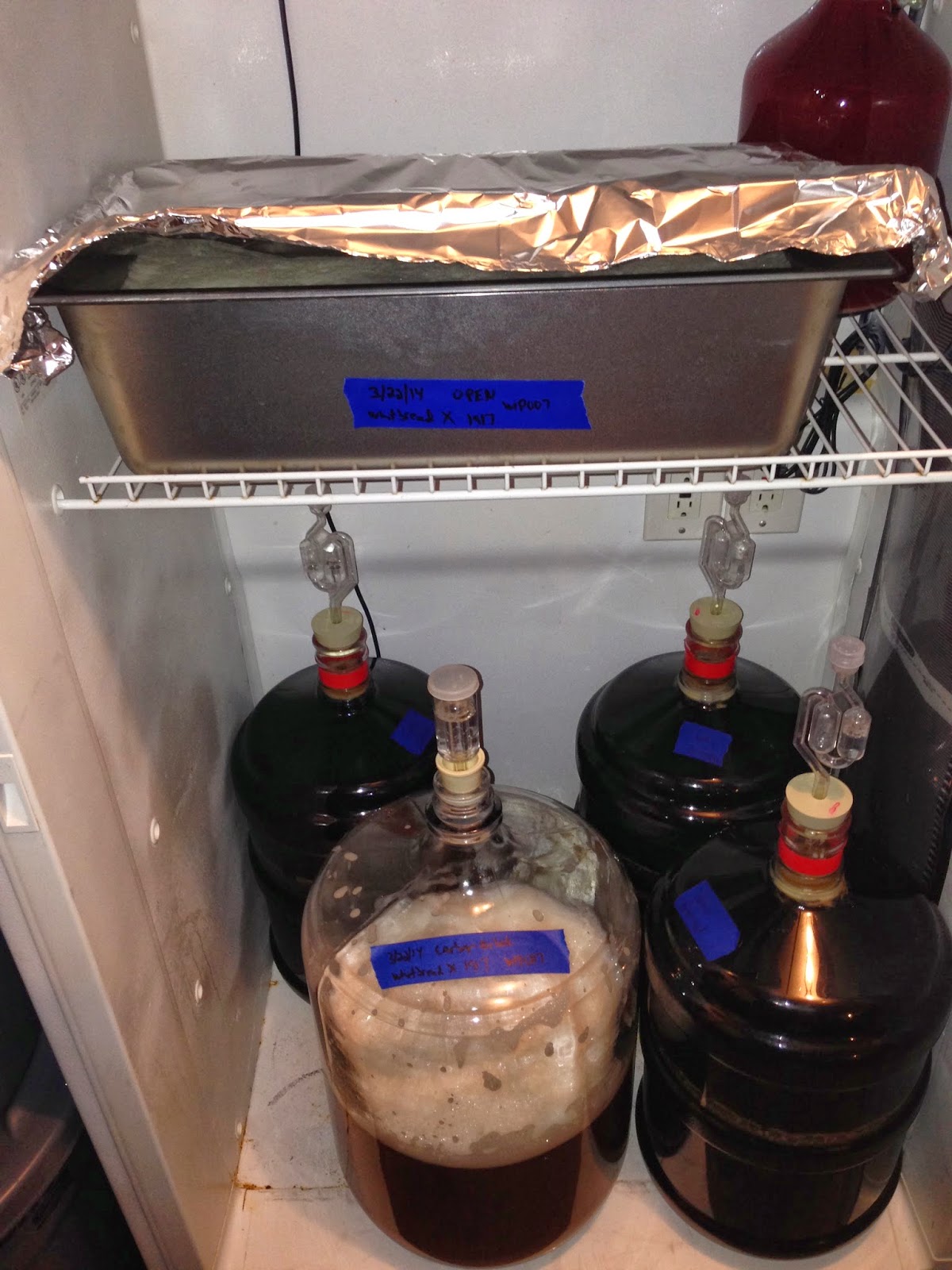
I brewed a 7 gallon batch and split it between two vessels.
1 6 gallon glass carboy with 3.5 gallons topped with an airlock, and 3.5 gallons in a 5.5 gallon stainless steel square topped with tin foil. I'll skim the excess yeast in the square during fermentation.
WLP007 - Wyeast 1098
Temperature - 63 degrees.
I was going to use Wyeast 1099 but that strain is a little too blah for me. This X has a lot of hops and I want those hops to come through, so I used the 1098 strain.
I also used a PH meter for the first time in this brew. I have used the good strips before, but after reading the Water book I decided I wanted to take advantage of the knowledge.
Check ph in mash with ph meter.
These beers will be on my beer engine before you know it.
Update: I dirt skimmed the yeast after 24 hours in the square. There was a replacement krausen when I checked the square 4 hours later. I checked the square after 48 hours and the krausen is gone. There is a thin layer of yeast finishing up the fermentation.
The carboy still has a healthy krausen going.
Same beer, same volume, same yeast. The yeast was pitched by volume out of a measured flask.
The open ferment seems to be faster. I recovered the square with foil and will take a gravity reading of both when I transfer to cask.
Tasting notes.
I have both of these beers on a beer engine. I casked them each with 20g EKG, 80g corn sugar in boiled water, 1/2 packet gelatin in water 170F.
Open fermented beer finished at 1.009 and carboy finished at 1.010.
Open fermented beer is not as bright as carboy beer. The invert sugar comes across a little more in the open ferment and the hops come out brighter in the carboy beer. However I would say in a blind taste test in would be hard to tell the difference between the two.
Findings:
I would say wlp007 doesn't have much of a difference between open ferment and a carboy at fermentation temperature of 63 degrees.
Michael was talking about the effect of head pressure and space during fermentation. He referenced research I performed on fermenter geometry in his writing. He suggested a few readers submit their results regarding fermentations. I agree to submit my findings.
I brewed a English Mild from Ron's blog - 1917 Whitbread X.
OG 1.045
Lots of different base malts, English hops, American Hops, invert sugar.
I brewed a 7 gallon batch and split it between two vessels.
1 6 gallon glass carboy with 3.5 gallons topped with an airlock, and 3.5 gallons in a 5.5 gallon stainless steel square topped with tin foil. I'll skim the excess yeast in the square during fermentation.
WLP007 - Wyeast 1098
Temperature - 63 degrees.
I was going to use Wyeast 1099 but that strain is a little too blah for me. This X has a lot of hops and I want those hops to come through, so I used the 1098 strain.
I also used a PH meter for the first time in this brew. I have used the good strips before, but after reading the Water book I decided I wanted to take advantage of the knowledge.
Check ph in mash with ph meter.
5.71 no salts - 3.5gallons water.
5.45 - 1g gysum, 1g calcium chloride
5.34 - 1g gysum, 1g calcium chloride
Sparged to 2Brix - 1.008. PH of mash was 5.81 when I stopped sparging.
End of boil ph was 5.64.
Might try acidify sparge water to try to control my ph better or maybe collect less wort.
This brew was also the first time I used my newly design false bottom. I used a combination of whole leaf hops and pellet hops. This false bottom worked well. I had a few seeds get by the bottom and into the pump but overall was pleased with the outcome. It's like my old kettles after the whirlpool and gives me more options on brew day.
These beers will be on my beer engine before you know it.
Update: I dirt skimmed the yeast after 24 hours in the square. There was a replacement krausen when I checked the square 4 hours later. I checked the square after 48 hours and the krausen is gone. There is a thin layer of yeast finishing up the fermentation.
The carboy still has a healthy krausen going.
Same beer, same volume, same yeast. The yeast was pitched by volume out of a measured flask.
The open ferment seems to be faster. I recovered the square with foil and will take a gravity reading of both when I transfer to cask.
Tasting notes.
I have both of these beers on a beer engine. I casked them each with 20g EKG, 80g corn sugar in boiled water, 1/2 packet gelatin in water 170F.
Open fermented beer finished at 1.009 and carboy finished at 1.010.
Open fermented beer is not as bright as carboy beer. The invert sugar comes across a little more in the open ferment and the hops come out brighter in the carboy beer. However I would say in a blind taste test in would be hard to tell the difference between the two.
Findings:
I would say wlp007 doesn't have much of a difference between open ferment and a carboy at fermentation temperature of 63 degrees.
Thursday, March 13, 2014
Brewery update 03/12/2014
Added an option for the boil kettle. I had a false bottom fabricated and then altered it to fit my custom kettle. This will allow brewing with leaf hops without using mesh bags. It also allows me to use a immersion wort chiller in the kettle without having it lean it on the heating element.
The false bottom is perforated stainless steel not the Blichmann slotted false bottom. I used a grinder disk and flap wheel to get the bottom to fit the kettle and then used a step bit to make two holes for legs. The bottom rests on the kettle pickup tool nut, and then I built two stainless steel legs out of 3/8" threaded rod and four nuts.
I'll have to test out how it affects hop extraction, whirlpooling, and the overall brew day.
The false bottom is perforated stainless steel not the Blichmann slotted false bottom. I used a grinder disk and flap wheel to get the bottom to fit the kettle and then used a step bit to make two holes for legs. The bottom rests on the kettle pickup tool nut, and then I built two stainless steel legs out of 3/8" threaded rod and four nuts.
I'll have to test out how it affects hop extraction, whirlpooling, and the overall brew day.
Cherry Wine - 03/12/2014
I used some of last year's frozen sour cherries to make a small batch of cherry wine.
8.5# cherries
2.5# white sugar
3.5L boiled filtered water
2G Go-ferm
1G fermaid K after 24 hr, 1G after 3 days.
1t pectic enzyme
.5t tannin
Lavlin ec-1118
Sunday, March 2, 2014
Penace Porter 03/02/2014
I was able to order a few vials of brettanomyces that haven't been available commercially before.
The supplier is a company called The Yeast Bay and they use White Labs for propagation.
I've been on a historical English beer kick lately. I decided to brew a porter with a nod to history and include some aged character via brettanomyces. I then split the batch three ways and pitched 150ml of regular saccharomyces (Whitbread 1099) and a vial of brettanomyces (brettanomyces beersel, brettanomyces brussels, brettanomyces lochristi).
The grist composed of a blend of two pale malts (optic, golden promise), american 6 row, rye malt, torrified wheat, Crystal 40, victory malt, pale chocolate malt and invert no. 4 sugar.
I have seen all of the malts (except the victory) in historical porter brewing logs.
Bittering hops Belma, aroma hops Strisslespalt and East Kent Goldings.
After a long fermentation, each batch will be dry hopped with a small amount of Styrian Goldings.
Subscribe to:
Posts (Atom)